
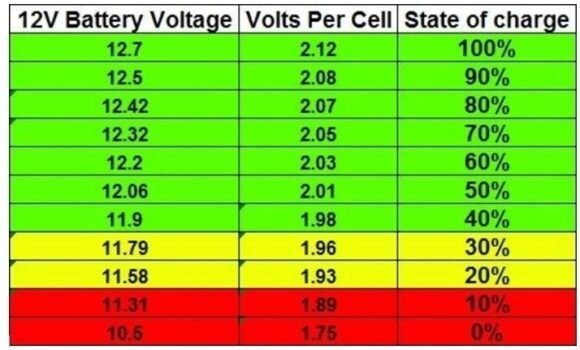
A 12-volt battery voltage chart is a crucial reference tool that shows the state of charge based on voltage readings. It helps you diagnose battery health and prevent unexpected failures. This guide provides the expert data you need.
Understanding your battery’s voltage is key to maximizing its lifespan and performance. A simple multimeter reading, compared to the correct chart, can save you from costly replacements and inconvenient breakdowns.
Best Tools for Testing 12 Volt Battery Voltage
Klein Tools MM325 Multimeter – Best Overall Tester
This digital multimeter offers auto-ranging functionality and a clear backlit display, making voltage readings quick and accurate. It’s a professional-grade tool built for durability. It’s the ideal choice for both DIY enthusiasts and technicians who need reliable, everyday testing.
ANCEL BA101 Professional Battery Analyzer
Go beyond simple voltage with this advanced analyzer. It performs load tests, measures CCA (Cold Cranking Amps), and assesses battery health with a detailed printout. This is the best option for diagnosing starting problems and getting a complete picture of your battery’s condition.
NOCO Genius1 Battery Maintainer
This isn’t a tester, but a crucial maintenance tool. It uses smart charging technology to prevent sulfation and maintain optimal voltage during storage. It’s ideal for seasonal vehicles, motorcycles, or any battery that sits unused, extending its lifespan significantly.
12 Volt Battery Voltage Readings
Interpreting a 12V battery voltage chart correctly is essential for accurate diagnostics. Voltage alone tells a story about charge level and overall health. You must know the conditions under which you measure it.
The most critical factors are whether the battery is at rest, under load, or being charged. Each state provides different voltage readings. Using the wrong reference can lead to incorrect conclusions about your battery’s condition.
Key Voltage States and Their Meanings
A healthy, fully charged 12-volt battery should measure about 12.6 to 12.8 volts at rest with no load. This “resting voltage” is your baseline for the state of charge. Any surface charge must be removed for an accurate reading.
When the engine is running, the charging system takes over. You should see a voltage between 13.7 and 14.7 volts at the battery terminals. This indicates the alternator is properly charging the battery.
Detailed 12V Battery Voltage Chart
This chart shows the approximate state of charge based on a resting voltage reading. Always confirm with a hydrometer or load test for absolute certainty.
| State of charge | Voltage range (resting) | Condition / notes |
|---|---|---|
| 100% | 12.6V – 12.8V | Fully charged, healthy |
| 90% | 12.5V – 12.6V | Strong charge |
| 80% | 12.4V – 12.5V | Adequately charged |
| 70% | 12.3V – 12.4V | Slightly discharged |
| 60% | 12.2V – 12.3V | Moderate discharge; recharge soon |
| 50% | 12.1V – 12.2V | Partially discharged; may struggle in cold |
| 40% | 12.0V – 12.1V | Low; recharge needed |
| 30% | 11.9V – 12.0V | Very low; risk of no‑start |
| 20% | 11.8V – 11.9V | Severely discharged; urgent recharge |
| 10% | 11.7V – 11.8V | Near fully discharged; possible damage |
| 0% | Below 11.7V | Fully discharged; likely sulfation/damage |
Key Takeaway: A reading of 12.4 volts means your battery is only about 75% charged. Consistently operating below 12.4V can cause permanent sulfation damage, drastically shortening battery life.
How to Measure Voltage Accurately
For a true resting voltage, the battery must sit disconnected for several hours. Follow these steps for a proper check:
- Turn off all loads: Ensure the vehicle and all accessories are off.
- Set your multimeter: Select the DC voltage setting to 20V.
- Connect the probes: Touch red to positive (+), black to negative (-) terminal.
- Read the display: Note the voltage and compare it to the chart above.
How Temperature Affects 12V Battery Voltage and Performance
Temperature is a critical factor that your voltage chart must account for. Battery chemistry is highly sensitive to heat and cold. Ignoring temperature leads to incorrect state-of-charge estimates.
Cold temperatures increase a battery’s internal resistance. This makes it harder to deliver power, even if the voltage appears normal. Heat accelerates chemical activity and can cause permanent damage through excessive water loss.
Voltage Adjustments for Temperature
You must adjust your voltage reading based on the battery’s temperature. A “fully charged” voltage reading changes with the ambient conditions. Use this simple reference guide for accurate interpretation.
| Battery TemperatureAdjustment to ReadingFully Charged Voltage (Adjusted) | ||
|---|---|---|
| 100°F (38°C) | Add 0.032V | ~12.83V |
| 80°F (27°C) | Add 0.016V | ~12.81V |
| 60°F (16°C) | No adjustment | ~12.6V – 12.8V |
| 40°F (4°C) | Subtract 0.016V | ~12.78V |
| 20°F (-7°C) | Subtract 0.032V | ~12.76V |
| 0°F (-18°C) | Subtract 0.048V | ~12.74V |
Key Takeaway: A battery reading 12.65V at 20°F is actually fully charged. Without temperature correction, you might mistakenly think it needs charging. Always consider temperature for an accurate diagnosis.
Why Cold Cranking Amps (CCA) Matter in Winter
Voltage alone doesn’t tell the whole story in cold weather. Cold Cranking Amps (CCA) measure a battery’s ability to start an engine in freezing temperatures. A battery can show decent voltage but fail to deliver sufficient amps.
Low temperatures drastically reduce available power. A battery rated for 600 CCA at 32°F may only deliver 300 CCA at 0°F. This is why winter starting problems are common, even with a battery that tests “charged” by voltage alone.
Pro Tips for Seasonal Battery Care
- Winter Preparation: Test voltage and CCA before cold weather hits. Ensure terminals are clean and tight to minimize resistance.
- Summer Maintenance: Check electrolyte levels regularly in hot climates. Heat accelerates water loss, which can damage plates.
- Storage Advice: Store batteries in a cool, dry place and keep them on a maintenance charger. This prevents discharge and sulfation.
Diagnosing Common Battery Problems Using Voltage
Your 12-volt battery voltage chart is a powerful diagnostic tool. Specific voltage readings can pinpoint common failure modes. This helps you decide between recharging, maintaining, or replacing the battery.
Voltage tests are fast and non-invasive. They provide the first clue about your battery’s health. Always follow a voltage check with a load test for a definitive diagnosis, especially for starting problems.
Interpreting Critical Voltage Readings
Certain voltage levels are clear indicators of specific issues. Recognizing these patterns saves time and money.
- Below 12.0V (Resting): Indicates a deep discharge. Recharge immediately. Prolonged time at this voltage causes permanent sulfation.
- 12.4V – 12.6V (After Driving): Battery may not be accepting a full charge. This suggests potential alternator or regulator issues, not just a bad battery.
- Above 12.8V (Resting) for Standard Batteries: Could indicate an overcharged condition, often from a faulty charger. This damages plates and boils off electrolyte.
Key Takeaway: A battery that reads 10.5 volts or lower under engine cranking load is likely faulty, even if its resting voltage seems okay. This is a classic sign of a weak cell.
Surface Charge vs. True Resting Voltage
A surface charge is a false-high voltage reading on the battery’s surface. It occurs right after charging or driving. This voltage will quickly drop and gives an inaccurate state-of-charge reading.
To remove surface charge for an accurate test, turn on the headlights for two minutes. Then, turn them off and wait five minutes before measuring. This dissipates the surface charge and reveals the true resting voltage.
Voltage Drop Testing for Electrical Issues
Sometimes the battery is fine, but voltage doesn’t reach where it’s needed. A voltage drop test checks for excessive resistance in cables and connections.
- Set multimeter to DC volts.
- With a load applied (like headlights), probe across each connection (battery post to terminal, terminal to cable end).
- A reading above 0.2 volts indicates a bad connection that needs cleaning or tightening.
This test finds hidden problems that a simple battery voltage check will miss. It ensures power flows efficiently from the battery to the starter and electrical system.
Maintaining Optimal 12V Battery Voltage and Health
Proper maintenance directly correlates with stable, healthy voltage readings. A well-maintained battery performs reliably and lasts longer. This section outlines proactive steps to keep your voltage in the ideal range.
Consistent care prevents the most common causes of premature failure. These include sulfation, stratification, and chronic undercharging. Simple habits can add years to your battery’s service life.
Essential Maintenance Schedule and Tasks
Follow this routine to ensure your battery maintains optimal voltage and capacity. Consistency is more important than complexity.
- Monthly: Check terminal connections for tightness and corrosion. Clean with a baking soda solution and a wire brush if needed.
- Every 3 Months: Measure and record the resting voltage. For flooded lead-acid batteries, check and top up electrolyte levels with distilled water.
- Seasonally (Before Summer/Winter): Perform a full diagnostic: resting voltage, load test, and visual inspection for cracks or bulges.
Key Takeaway: The single best practice is to never let your battery sit in a partially discharged state. Recharge it immediately after use if the voltage drops below 12.4V to prevent damaging sulfation.
Choosing the Right Battery Charger
Using a quality charger is crucial for maintaining voltage. Modern smart chargers or battery maintainers are ideal. They automatically adjust the charge rate and switch to a maintenance float mode.
Avoid old, manual chargers that can overcharge. Look for chargers with these features:
- Automatic voltage detection and multi-stage charging (Bulk, Absorption, Float).
- Desulfation mode to help recover lightly sulfated batteries.
- Compatibility with your battery type (Flooded, AGM, Gel).
Long-Term Storage Guidelines
Storing a battery incorrectly is a leading cause of failure. The goal is to prevent self-discharge from dropping the voltage into the danger zone.
- Fully charge the battery to 12.6V+ before storage.
- Disconnect the negative terminal to prevent parasitic drain from the vehicle.
- Store in a cool, dry place, away from concrete floors if possible (a modern myth, but good for organization).
- Connect a battery maintainer or recharge every 1-2 months to keep voltage above 12.4V.
Following this storage protocol ensures your battery will be ready with full voltage when you need it again.
Advanced Testing: Going Beyond Basic Voltage Checks
While a voltage chart is essential, advanced tests provide a complete picture of battery health. Voltage indicates state of charge, but not necessarily the battery’s ability to deliver power. Combining tests leads to a definitive diagnosis.
These methods are crucial when voltage readings are ambiguous. They help determine if a weak battery needs replacement or if another system is at fault.
Load Testing vs. Conductance Testing
These are the two primary methods for assessing a battery’s cranking power. Both simulate the high-demand scenario of starting an engine.
| Test Type | How It Works | Best For |
|---|---|---|
| Load Test | Applies a high amperage load (half the CCA rating) for 15 seconds while monitoring voltage drop. | Traditional, highly accurate diagnosis of flooded lead-acid batteries. Requires a fully charged battery. |
| Conductance Test | Sends a small signal through the battery to measure its ability to conduct current. Fast and non-invasive. | Modern AGM/Gel batteries, quick checks, and testing batteries that cannot be fully charged first. |
Key Takeaway: A battery can show 12.6 volts at rest but fail a load test. This indicates it has capacity (charge) but cannot deliver power under strain, confirming it needs replacement.
How to Perform a Simple Load Test
You can perform a basic load test with a digital multimeter and a known load, like a headlight bulb.
- Ensure the battery is at least 75% charged (≥12.4V).
- Connect your load (e.g., a 55W headlight bulb draws ~4.5 amps).
- Let the load run for 2 minutes, then note the voltage.
- Disconnect the load and monitor the voltage recovery.
A healthy battery will see a minor voltage dip and quickly recover to near its original resting voltage. A weak battery will see a large, sustained drop and slow recovery.
When to Test Your Alternator’s Output
If your battery voltage is consistently low, the problem may be the charging system. Test the alternator with the engine running.
- At idle: Voltage at battery terminals should be 13.7V to 14.7V.
- With load (lights, A/C on): Voltage should remain above 13.0V.
- If voltage is below 13.0V or above 15.0V: The alternator or voltage regulator is likely faulty and not maintaining the system voltage correctly.
This test confirms whether your battery is being charged properly while driving.
12V Battery Voltage Chart for Different Battery Types
Not all 12-volt batteries are created equal. Your voltage chart must account for different battery chemistries. AGM, Gel, and Lithium batteries have unique voltage characteristics.
Using a standard flooded battery chart on an AGM battery can lead to misdiagnosis. Understanding these differences is key to proper charging, maintenance, and testing.
AGM vs. Flooded Lead-Acid Voltage Comparison
Absorbent Glass Mat (AGM) batteries have a lower internal resistance and different charge profiles. Their voltage readings at various states of charge are slightly higher than traditional flooded batteries.
| State of Charge | Flooded Battery Voltage | AGM Battery Voltage |
|---|---|---|
| 100% | 12.60V – 12.70V | 12.80V – 12.90V |
| 75% | ~12.40V | ~12.60V |
| 50% | ~12.20V | ~12.30V |
| 25% | ~12.00V | ~12.00V |
| 0% | 11.80V or less | 11.80V or less |
Key Takeaway: An AGM battery reading 12.8V is fully charged, while a flooded battery at the same voltage might be overcharged. Always use the correct chart for your battery type to avoid damage.
Lithium Iron Phosphate (LiFePO4) Voltage Profile
LiFePO4 batteries have an extremely flat discharge curve. Their voltage stays very stable until almost fully depleted. This makes a standard voltage chart less useful for estimating charge.
- Fully Charged: ~13.3V – 13.4V (per 12V nominal battery)
- Nominal Voltage: ~13.2V for most of the discharge cycle.
- Low Charge/Disconnect: ~10.0V – 11.0V (varies by BMS settings).
These batteries require a dedicated lithium charger and a Battery Management System (BMS). Never use a standard lead-acid charger on them.
Gel Cell Battery Voltage Considerations
Gel batteries are similar to AGM but are even more sensitive to overcharging. Their voltage thresholds are critical to prevent damage from outgassing, which can create permanent dry spots.
Key voltage points for Gel batteries:
- Float Charge Voltage: Must be precisely 13.8V or lower at 77°F (25°C).
- Bulk/Absorption Voltage: Typically 14.0V to 14.2V, but always follow manufacturer specs.
- Resting Full Charge: Approximately 12.8V – 13.0V.
Exceeding these voltages can permanently damage the gel electrolyte. Always use a charger with a dedicated Gel setting.
Troubleshooting Guide: Voltage Readings and Solutions
This actionable guide helps you diagnose and fix common problems based on your voltage readings. Match your symptom to the voltage scenario for a targeted solution. Always prioritize safety and disconnect the battery before cleaning terminals.
Follow these steps methodically to isolate the issue. Start with the simplest checks before moving to complex diagnostics or part replacement.
Scenario 1: Battery Won’t Hold a Charge (Voltage Drops Quickly)
If your battery voltage falls rapidly after charging, you have a drain or a failing battery. First, determine which is the culprit.
- Test for Parasitic Drain: Set multimeter to amps. Disconnect negative terminal. Connect meter between terminal and post. A reading above 50 milliamps (0.05A) indicates an excessive drain.
- Isolate the Drain: Pull fuses one by one while watching the ammeter. When the reading drops, you’ve found the faulty circuit.
- Load Test the Battery: If no drain is found, the battery itself is likely sulfated or has a shorted cell and needs replacement.
Key Takeaway: A fast voltage drop is often due to a parasitic drain from a stuck relay, glove box light, or aftermarket accessory, not a bad battery. Always test for drain first.
Scenario 2: Low System Voltage While Driving
If your voltage at the battery terminals is below 13.7V with the engine running, the charging system is failing. This will eventually drain your battery.
- Symptom: 12.5V – 13.5V while driving. Likely a failing alternator or a loose serpentine belt. Check belt tension and alternator connections.
- Symptom: Intermittent voltage spikes/drops. Could be a bad voltage regulator (often inside the alternator) or corroded wiring.
- Symptom: Voltage is normal but battery dies. Perform a voltage drop test on the positive and negative cables to find high resistance.
Scenario 3: Battery Reads Zero or Very Low Voltage
A reading of 0-2 volts often indicates a completely dead battery or an open circuit. Do not attempt to jump-start immediately.
First, check for a blown main fuse or severely corroded terminals creating an open circuit. Clean terminals thoroughly. If the battery is truly at 0V, it may have a sulfated or internally shorted cell.
Attempt a slow, low-amp charge with a smart charger that has a repair/desulfation mode. If the voltage doesn’t rise above 10V within an hour, the battery is likely unrecoverable and must be replaced.
Conclusion: Mastering Your 12 Volt Battery Voltage Chart
Understanding your 12V battery voltage chart is essential for reliable performance. It empowers you to diagnose issues early and take proactive maintenance steps. This knowledge saves money and prevents inconvenient breakdowns.
The key takeaway is to measure voltage correctly and interpret it in context. Always consider battery type, temperature, and whether the battery is at rest or under load.
Start by testing your own battery’s resting voltage today. Compare it to the charts in this guide to assess its health. Invest in a quality multimeter or battery maintainer for long-term care.
With this guide, you have the expert knowledge to keep your battery at its optimal voltage for years to come.
Frequently Asked Questions about 12 Volt Battery Voltage
What is a good voltage for a 12 volt battery?
A fully charged and healthy 12V battery should read between 12.6 and 12.8 volts at rest with no load. This is measured after the battery has sat for several hours. For AGM batteries, a reading up to 12.9V is normal when fully charged.
If you measure immediately after driving, you may see a higher surface charge. Always check resting voltage for an accurate state-of-charge assessment using a reliable voltage chart.
At what voltage is a 12V battery considered dead?
A 12V battery is considered fully discharged at approximately 11.8 volts at rest. At this voltage, it has effectively 0% state of charge. Operating a battery at this level causes severe sulfation, which permanently damages its capacity.
For starting purposes, a battery that drops below 10.5 volts while cranking the engine is considered dead, even if its resting voltage is higher. This indicates it cannot deliver the necessary power.
How to tell if a 12V battery is bad with a multimeter?
First, measure the resting voltage. A reading below 12.0V suggests a deep discharge. Next, perform a load test by checking voltage while cranking the engine or applying a high-beam load.
If the voltage drops significantly below 10V under load and does not recover quickly, the battery is likely bad. A surface charge can be misleading, so ensure you test correctly.
What should a 12V battery read when the car is running?
With the engine running, your multimeter should show between 13.7 and 14.7 volts at the battery terminals. This indicates the alternator is actively charging the battery and powering the vehicle’s electrical systems.
If the reading is below 13.7V, the alternator may be undercharging. A reading above 15.0V indicates overcharging, which can damage the battery and electronics by boiling the electrolyte.
Is 12.2 volts enough to start a car?
12.2 volts indicates the battery is only about 50% charged. While it might start a car in warm weather, it is a risk. The battery has significantly reduced capacity and Cold Cranking Amps (CCA).
In cold temperatures, a battery at 12.2V will likely fail to start the engine. You should recharge it immediately to prevent further discharge and potential damage from sulfation.
How to recharge a 12V battery correctly?
Use a modern smart charger that automatically adjusts the charge rate. Connect the red clamp to the positive (+) terminal and black to the negative (-). Ensure the charger is set to the correct battery type (flooded, AGM, Gel).
Charge until the charger indicates completion or the battery reaches 12.6V+ at rest. Avoid using high-amp “boost” modes for extended periods, as they can overheat and damage the battery.
What is the difference between resting voltage and surface charge?
Resting voltage is the true, stable voltage of a battery after it has sat for several hours. Surface charge is a false-high voltage layer on the battery plates immediately after charging or driving.
To get an accurate reading, you must remove the surface charge. Turn on your headlights for two minutes, then turn them off and wait five minutes before measuring the resting voltage with your multimeter.
Can a battery show good voltage but still be bad?
Yes, this is common. A battery can show 12.6V at rest but fail to deliver power under load due to internal damage, sulfation, or a weak cell. Voltage measures electrical potential, not power capacity.
This is why a load test or conductance test is crucial for a complete diagnosis. These tests reveal if the battery can provide the high amperage needed to start an engine, which a simple voltage check cannot.