
A 48V battery voltage chart is a critical reference tool that shows the relationship between a battery’s voltage and its state of charge (SOC). This guide provides the exact voltage ranges for different 48V battery chemistries. Understanding these readings is essential for maximizing battery life and performance.
Using the correct voltage chart prevents damage from over-discharging and helps you accurately gauge remaining power. It solves the problem of guessing your battery’s true capacity, which can lead to unexpected power loss or reduced lifespan.
Best Tools for Monitoring 48V Battery Voltage
Klein Tools MM720 Multimeter – Best Overall Choice
The Klein Tools MM720 is a professional-grade digital multimeter ideal for accurate 48V battery diagnostics. It features True-RMS for precise AC/DC voltage readings and a large backlit display. Its rugged design and auto-ranging functionality make it the best overall tool for technicians and serious DIY enthusiasts who need reliable, repeatable measurements.

- VERSATILE FUNCTIONALITY: Measures AC/DC voltage up to 1000V, 10A AC/DC…
- LOW IMPEDANCE MODE: LoZ mode for identifying and eliminating ghost or stray…
Victron Energy BMV-712 Smart Battery Monitor – Best for System Integration
For comprehensive system monitoring, the Victron Energy BMV-712 is the top recommendation. This device provides real-time data on state of charge, voltage, and current via Bluetooth. It’s the best option for solar power, RV, or marine applications where continuous, precise tracking of your 48V bank’s health is critical for performance and longevity.

- COMPREHENSIVE BATTERY MONITORING: The Victron Energy BMV-712 Smart Battery…
- ADDITIONAL INPUT: Victron Energy BMV-712 features an additional input which…
ANCEL BA101 Professional Battery Analyzer – Best for Advanced Diagnostics
The ANCEL BA101 goes beyond simple voltage checks to offer advanced battery and charging system analysis. It tests CCA, health, and charge status for 48V systems. This tool is ideal for automotive professionals or fleet managers who need a quick, definitive diagnosis to prevent failures and optimize battery life across multiple vehicles.

- Catch Battery Problems Early: Featured in two videos by Project Farm, a…
- Know the Real Condition: Don’t let inaccurate readings lead to costly…
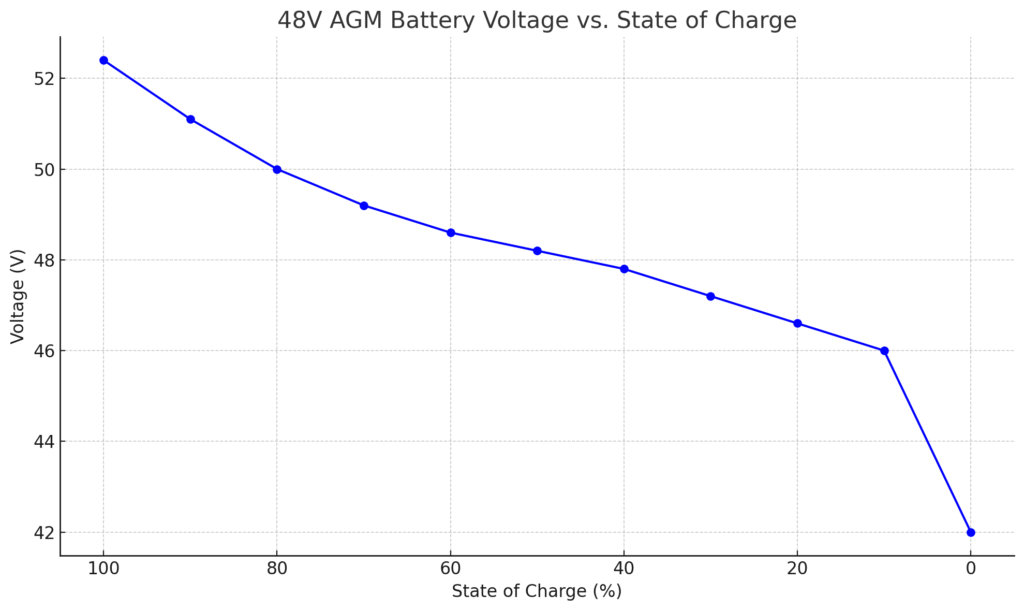
48V Battery Voltage and State of Charge
A 48V battery’s voltage directly indicates its State of Charge (SOC). This is the percentage of remaining capacity. Different battery chemistries have unique voltage profiles, making a specific chart essential for accurate monitoring and maintenance.
| State of Charge (%) | Voltage (V) |
|---|---|
| 100% | 52.0 – 52.8 (charging) |
| 90% | 51.1 |
| 80% | 50.0 |
| 70% | 49.2 |
| 60% | 48.6 |
| 50% | 48.2 |
| 40% | 47.8 |
| 30% | 47.2 |
| 20% | 46.6 |
| 10% | 46.0 |
| 0% | 42.0 or lower |
Why Voltage Charts Are Critical for Battery Health
Using the correct voltage chart prevents two major issues: over-discharging and under-charging. Both can permanently damage battery cells and drastically shorten their lifespan. Accurate voltage readings are your first line of defense in a proper battery management strategy.
- Prevents Over-Discharge: Draining a battery below its safe voltage threshold causes irreversible sulfation in lead-acid and cell damage in lithium-ion batteries.
- Ensures Proper Charging: Charts help identify when a battery is fully charged, preventing undercharging (which leaves capacity unused) or overcharging (which creates heat and stress).
- Enables Accurate Diagnostics: A voltage reading that doesn’t align with the expected SOC can signal a failing cell, poor connections, or an imbalance within the battery pack.
Key Voltage Points for a 48V System
While full charts are chemistry-specific, every 48V system operator should know these universal voltage landmarks. These are the critical thresholds for safe operation.
| Voltage Reading | State of Charge Indicator | Recommended Action |
|---|---|---|
| 50.0V – 54.6V | Fully Charged (100%) | Charge complete. Disconnect or maintain with float charge. |
| 48.0V – 50.0V | Healthy Operating Range (~50-80%) | Normal use. Optimal range for performance and longevity. |
| 45.0V – 48.0V | Low Charge (20-50%) | Plan for recharging soon to avoid deep discharge. |
| Below 42.0V | Deeply Discharged (0%) | IMMEDIATE RECHARGE REQUIRED. Risk of permanent damage. |
Remember, these are general guidelines. Always consult your battery manufacturer’s specifications for the most accurate voltage parameters for your specific model.
48V Lithium-Ion vs. Lead-Acid Voltage Charts Compared
Lithium-ion and lead-acid 48V batteries have fundamentally different voltage profiles. Using the wrong chart can lead to incorrect state-of-charge estimates and potential damage. This section provides the precise voltage charts for each chemistry.
48V Lithium-Ion (LiFePO4) Battery Voltage Chart
Lithium Iron Phosphate (LiFePO4) batteries have a very flat voltage curve during discharge. This means the voltage stays relatively stable until it nears empty. Their nominal voltage is 51.2V for a 16-cell series configuration.
| State of Charge (SOC) | 48V LiFePO4 Voltage | Condition |
|---|---|---|
| 100% | 58.4V | Fully charged (absorption voltage). |
| 90% | 54.4V | Resting voltage after charge. |
| 50% | 51.2V | Nominal voltage at mid-capacity. |
| 20% | 50.0V | Recommended recharge point. |
| 0% | 40.0V | Fully discharged (AVOID this level). |
48V Lead-Acid (AGM/Flooded) Battery Voltage Chart
Lead-acid batteries have a more linear and sloping voltage curve. Voltage readings must be taken at rest (after 2+ hours without charge or load) for accuracy. A 48V system typically consists of four 12V batteries in series.
| State of Charge (SOC) | 48V Lead-Acid Voltage | Condition |
|---|---|---|
| 100% | 50.9V – 51.3V | Fully charged and rested. |
| 75% | 50.2V | Healthy for daily cycling. |
| 50% | 49.2V | 50% Depth of Discharge – recharge now. |
| 25% | 48.4V | Deeply discharged – risk of damage. |
| 0% | 46.2V | Fully depleted – immediate recharge critical. |
Key Takeaway: Never use a lead-acid voltage chart for a lithium battery, or vice-versa. The resting voltage is crucial for accurate lead-acid readings, while lithium voltages are more stable under load.
How to Read and Use a 48V Battery Voltage Chart
Knowing the chart values is only half the battle. Accurate measurement technique is essential for correct interpretation. Follow this step-by-step guide to get reliable readings and take appropriate action based on the results.
Step-by-Step Guide to Measuring Battery Voltage
For accurate state-of-charge assessment, you must measure voltage correctly. Incorrect technique leads to misleading data and poor battery management decisions.
- Safety First: Wear safety glasses. Ensure the area is dry and well-ventilated. Identify the positive (+) and negative (-) terminals on your 48V battery bank.
- Prepare Your Multimeter: Set your digital multimeter to the DC Voltage (V⎓) setting. Choose a range that includes at least 60V to safely measure the 48V system.
- Take the Reading: Connect the red probe to the positive terminal and the black probe to the negative terminal. Hold the probes firmly for a stable reading on the display.
- Interpret the Result: Note the exact voltage. Compare it to the correct voltage chart for your battery chemistry (LiFePO4 or Lead-Acid) to determine the State of Charge.
Correcting Voltage Readings for Temperature
Battery voltage is affected by ambient temperature. A reading taken in cold weather will be lower than the actual capacity, while a hot reading will be higher. This requires a simple correction for accuracy.
- Cold Temperatures (<20°C / 68°F): Voltage reads lower. Add approximately 0.003V per cell per °C below 25°C. For a 48V lead-acid pack, this can mean adding 0.3V-0.5V to your reading in freezing conditions.
- Hot Temperatures (>30°C / 86°F): Voltage reads higher. Subtract voltage accordingly. High temperatures also accelerate chemical degradation, so monitoring is crucial.
- Best Practice: Always try to measure and charge batteries at room temperature (20-25°C / 68-77°F) for the most accurate chart correlation.
Pro Tip: For the most accurate SOC, measure voltage under a small, consistent load for lead-acid batteries, or at rest for lithium. Note the temperature and adjust your chart reference accordingly.
Common 48V Battery Voltage Problems and Solutions
Even with a voltage chart, you may encounter readings that signal underlying issues. Diagnosing these problems early can save your battery bank. Here are the most common voltage-related problems and how to fix them.
Diagnosing Low Voltage and Voltage Drop
A voltage reading significantly lower than the chart indicates for the expected SOC is a major red flag. This is often caused by voltage drop or a weak cell.
- Symptom – Under Load: Voltage plunges when a load is applied but recovers when disconnected. This indicates high resistance from corroded terminals, loose connections, or undersized cables.
- Symptom – At Rest: Voltage remains low even after charging and resting. This points to a deeply discharged cell, sulfation in lead-acid batteries, or aging cells that can no longer hold a charge.
- Solution: Clean all terminals and tighten connections. Test each individual battery or cell in the 48V series string. Any unit reading 10-15% lower than the others needs rebalancing or replacement.
Addressing High Voltage and Overcharging
Persistently high voltage readings are equally dangerous. They often stem from charger malfunctions and can lead to thermal runaway, especially in lithium-ion batteries.
- Symptom: Voltage consistently reads at or above the absorption/boost level (e.g., 58V+ for LiFePO4) even after the charge cycle should be complete.
- Primary Cause: A faulty charge controller or charger that fails to switch from absorption to float stage. This continuously pumps energy into an already full battery.
- Immediate Action: Disconnect the charger immediately. Verify charger settings match your battery’s specifications. Use a multimeter to test the charger’s output voltage independently. Replace the charger if it’s defective.
Troubleshooting Summary: Use your voltage chart as a diagnostic map. A low voltage points to connection issues or cell failure. A high voltage signals charger problems. Regular monitoring is your best defense.
Maintenance Tips Using Your 48V Voltage Chart
Your voltage chart is a proactive maintenance tool, not just a diagnostic one. Integrating regular voltage checks into your routine extends battery life and ensures reliability. Here’s how to build a simple, effective maintenance schedule.
Creating a Weekly and Monthly Check Routine
Consistency is key to catching small issues before they become big failures. A quick voltage check takes only minutes but provides invaluable data on your system’s health.
- Weekly Check: Record the resting voltage of your entire 48V bank. Note it in a log alongside the date. This establishes a performance baseline and highlights any gradual decline.
- Monthly Deep Check: Measure the voltage of each individual battery (or cell block) in the series string. Voltage imbalance is a primary killer of battery packs. Any unit varying by more than 0.5V from the others needs attention.
- Post-Operation Check: After heavy use, check the voltage to ensure you haven’t exceeded the recommended 50% Depth of Discharge (DOD). Recharge immediately if you are near or below this threshold.
Optimal Charging Practices Based on Voltage
Use your voltage readings to guide charging, not just a timer. This ensures batteries are fully saturated without being overcharged, maximizing cycle life.
- Initiate Charge: Begin charging when voltage indicates approximately 20-30% State of Charge. For LiFePO4, this is around 52V. For lead-acid, it’s near 49V.
- Monitor Absorption: During the bulk/absorption stage, voltage will rise to its peak (58.4V for LiFePO4, ~57.6V for AGM). The charger should hold this voltage until current tapers.
- Verify Float: Once charging is complete, the voltage should drop to a safe float level (54.4V for LiFePO4, 54V for AGM). Confirm your charger makes this transition correctly.
Maintenance Golden Rule: Never let a lead-acid battery sit below 50% SOC (≈49.2V). For LiFePO4, avoid staying below 20% SOC (≈50V) for extended periods. Regular voltage checks make this easy to enforce.
Advanced Applications: Golf Carts, Solar, and EVs
48V battery systems power critical applications where performance and reliability are non-negotiable. Understanding the specific voltage parameters for your use case is essential. Here’s how to apply the voltage chart in real-world scenarios.
48V Golf Cart Battery Voltage Deep Dive
Most electric golf carts use a 48V system composed of six 8V lead-acid batteries. Their deep-cycle nature means voltage management directly impacts range and battery lifespan.
- Full Charge Target: A fully charged and rested 48V golf cart pack should read between 50.9V and 51.3V. Anything lower indicates incomplete charging or aging batteries.
- Operating Voltage: During normal use, voltage will drop. To maximize battery life, recharge when the pack voltage under load hits approximately 48.4V (≈25% SOC). Avoid draining below this point.
- Post-Round Check: After 18 holes, let the cart sit for 30 minutes and check resting voltage. If it’s at or below 49.2V (50% DOD), you are consistently over-discharging and shortening battery life.
Solar Power and Electric Vehicle Considerations
In renewable energy and EV applications, the battery is the heart of the system. Voltage monitoring ensures efficiency and protects your investment.
- Solar System Sizing: Use the voltage chart to size your solar array and charge controller correctly. You must generate enough power to regularly bring the battery bank back to 100% SOC (50.9V for lead-acid, 54.4V for LiFePO4).
- EV & E-Bike Range Estimation: Voltage provides a more accurate range estimate than a simple “bar” display. Learn the voltage that corresponds to 50% capacity on your specific pack. This tells you exactly how much range you have left.
- Battery Management System (BMS): A quality BMS uses the voltage chart internally to balance cells and enforce safe limits. Ensure your BMS’s high and low voltage cut-offs are set according to your battery’s specific chemistry chart.
Application Insight: For golf carts, focus on the 50% DOD threshold (49.2V). For solar, prioritize reaching full absorption voltage daily. In all cases, matching your charger’s settings to the chart is the most critical step.
Expert Tips for Maximizing 48V Battery Lifespan
Beyond simple voltage monitoring, expert practices can double or triple your battery’s service life. These strategies leverage the voltage chart to make intelligent, long-term decisions. Implement them to protect your investment.
The 80/20 Rule for Lithium-Ion Batteries
For maximum cycle life in LiFePO4 batteries, avoid using the full voltage range. Operating within a partial state-of-charge window dramatically reduces stress.
- Optimal Range: Keep your 48V LiFePO4 battery between 20% and 80% SOC for daily use. This corresponds to a voltage range of approximately 50.0V to 54.4V for a rested battery.
- Why It Works: This practice minimizes the time spent at the high and low voltage extremes, where chemical degradation is accelerated. It significantly reduces capacity fade over thousands of cycles.
- Full Charges: Only perform a full 100% charge (to 58.4V) periodically, such as once a month, to allow the BMS to balance the cells. Use your voltage chart to identify these set points easily.
Preventing Sulfation in Lead-Acid Batteries
Sulfation is the primary cause of lead-acid battery failure. It occurs when batteries are left in a partially charged state. Your voltage chart is the best tool to prevent it.
- Never Store Partially Charged: If storing a lead-acid system, always charge it to 100% (50.9V+) first. A battery stored at 50% SOC will sulfate rapidly.
- Use a Maintenance Charger: During storage, connect a float charger that maintains the battery at the correct float voltage (approximately 54V for a 48V system). This prevents self-discharge from dipping into the danger zone.
- Equalize Periodically: For flooded lead-acid batteries, perform a controlled overcharge (equalization) as per manufacturer specs. This brings all cells to the same high voltage, breaking down sulfate crystals.
Lifespan Summary: For LiFePO4, stay in the middle of the voltage chart. For lead-acid, avoid the bottom and keep batteries fully charged when not in active use. This is the cornerstone of longevity.
Conclusion: Mastering Your 48V Battery Voltage Chart
A precise 48V battery voltage chart is your essential guide to battery health and longevity. It transforms guesswork into accurate diagnostics and informed maintenance. By applying the charts and techniques outlined, you can prevent damage and maximize performance.
The key takeaway is to use the correct chart for your battery chemistry and measure voltage regularly. Integrate these readings into a simple weekly check routine. This proactive habit is the single best practice for protecting your investment.
Start today by checking your battery’s resting voltage against the appropriate chart. Invest in a reliable multimeter or battery monitor for consistent, accurate data. Your batteries will reward you with longer life and more reliable power.
With this knowledge, you are equipped to manage any 48V system with confidence and expertise.
Frequently Asked Questions about 48V Battery Voltage
What is a normal resting voltage for a fully charged 48V battery?
A normal resting voltage depends entirely on battery chemistry. For a 48V lead-acid battery, expect 50.9V to 51.3V after a full charge and 2+ hours of rest. For a 48V LiFePO4 lithium battery, the fully charged resting voltage is typically around 54.4V.
These are “resting” voltages, meaning no charge or load is applied. Voltage readings taken immediately after charging will be artificially high and must settle for an accurate state-of-charge assessment using the chart.
How to tell if a 48V battery is bad using a voltage chart?
A bad battery will not hold a voltage consistent with its state of charge. If it reads at 100% but quickly plunges under a small load, it has lost capacity. Also, if a single battery in a series string reads 1.5V+ lower than the others, it is likely failing.
Compare your measured voltage to the chart after the battery has been fully charged and rested. A significant deviation, or an inability to reach the full charge voltage, indicates internal degradation, sulfation, or a dead cell.
What voltage should a 48V golf cart battery be when fully charged?
A 48V golf cart battery pack (six 8V batteries) should read between 50.9V and 51.3V when fully charged and at rest. Immediately after charging, the voltage may read higher (52V+), but it will drop to the resting range within a few hours.
Consistently failing to reach this voltage range signals undercharging, aging batteries, or a faulty charger. Regular voltage checks are the best way to monitor the health of your golf cart’s expensive battery pack.
Is 52 volts good for a 48V lithium battery?
52 volts is a healthy, partially charged state for a 48V LiFePO4 battery. It corresponds to roughly a 50-60% state of charge. This is actually within the ideal 80/20 usage range for maximizing lithium battery cycle life.
This voltage indicates substantial remaining capacity. It is a perfect voltage for storage or before planned use. You can continue to use the battery or charge it, but there is no urgency.
Why is my 48V battery showing 58 volts?
A 48V battery showing 58 volts is actively being charged in the absorption or boost stage. This is normal during charging, especially for lithium-ion systems where absorption voltage can be 58.4V. The voltage should drop to a float level once charging is complete.
If the battery reads 58V when NOT connected to a charger, this is a serious problem. It indicates a faulty Battery Management System (BMS), severe cell imbalance, or a defective charger that overcharged and damaged the battery.
What is the lowest safe voltage for a 48V LiFePO4 battery?
The lowest safe voltage before damage occurs is typically the BMS cut-off, around 40V for the entire pack. However, the recommended lowest voltage for daily use is 50.0V, which corresponds to about 20% State of Charge.
Consistently discharging below 50V (20% SOC) stresses the battery. To maximize lifespan, plan your recharges for when voltage drops to this level. Never rely on the BMS low-voltage disconnect for daily cycling.
How to balance cells in a 48V battery using voltage readings?
Balance cells by measuring the voltage of each series unit. For a 48V LiFePO4 pack with 16 cells, each should be within 0.05V of the others at a 50% SOC. Use a dedicated balancer or a charger with balancing function if voltages drift apart.
For lead-acid, measure each 12V or 8V battery. A difference over 0.5V indicates imbalance. A full, slow charge to 100% SOC can help equalize them. Persistent imbalance requires individual charging or battery replacement.
What is the best way to store a 48V battery long-term?
The best way is to store it at a partial charge in a cool, dry place. For lithium (LiFePO4), store at 50-60% SOC (approx. 52-53V). For lead-acid, store fully charged (50.9V+) and connect a maintenance float charger to prevent self-discharge.
Check the voltage every 2-3 months during storage. Recharge the lead-acid battery if it drops below 50V. For lithium, a top-up charge may be needed every 6-12 months if the BMS has a small parasitic drain.