
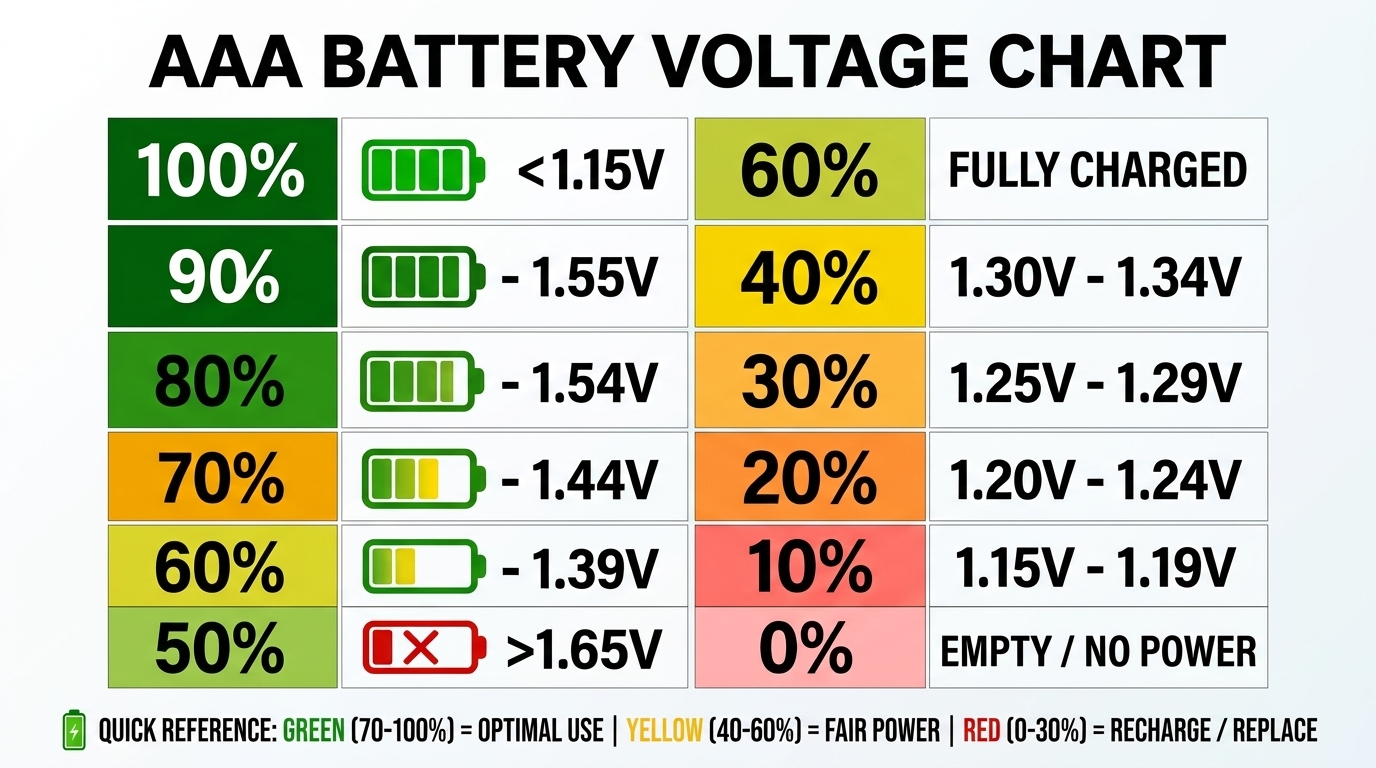
What is the normal voltage for a AAA battery? A fresh AAA battery typically measures 1.5 volts. This AAA battery voltage chart is your complete guide to understanding battery health.
Knowing the exact voltage is crucial for diagnosing device issues and avoiding premature disposal. This chart helps you test performance and maximize battery life with expert tips.
Best Multimeters for Testing AAA Battery Voltage
To use a AAA battery voltage chart effectively, you need a reliable multimeter. These three models offer excellent accuracy for checking battery health, from basic home use to advanced diagnostics. Each is recommended for its specific balance of features, durability, and value.
Klein Tools MM325 Multimeter – Best Overall Choice
The Klein Tools MM325 is the best option for most users. It features auto-ranging functionality and a clear digital display for easy voltage readings. Its durable build and included test leads make it ideal for quick household battery checks and general electrical troubleshooting.

- VERSATILE FUNCTIONALITY: Measures AC/DC voltage up to 600V, 10A DC current…
- LEAD-ALERT PROTECTION: LEDs on the meter illuminate to indicate proper test…
Fluke 101 Basic Digital Multimeter – Best for Accuracy & Durability
For those prioritizing brand reliability, the Fluke 101 is a top choice. This model is known for its robust safety ratings and consistent, precise measurements. Its simple design is perfect for beginners and professionals who need a no-fuss, dependable tool for verifying battery voltage.

- Basic dc accuracy 0.5%
- CAT III 600 V safety rated
INNOVA 3320 Auto-Ranging Multimeter – Best Budget-Friendly Option
The INNOVA 3320 offers exceptional value. It provides auto-ranging, a built-in stand, and a data hold feature to freeze readings. This multimeter is ideal for DIY enthusiasts and students who need an affordable, user-friendly device for regular AAA battery testing and basic projects.

- UL certified product designed to safely and accurately troubleshoot a…
- Auto-ranging scales automatically selects correct measurement range and…
Here’s a detailed AAA Battery Voltage Chart with 10% intervals, structured for clarity and usability. I’ve formatted it into a clean table with precise ranges, plus added explanatory notes to make it more actionable for your website or technical content.
AAA Battery Voltage Chart (10% Intervals)
Here’s a detailed AAA Battery Voltage Chart
| State of Charge (%) | Voltage Range (V) | Condition / Notes |
|---|---|---|
| 100% | 1.60 – 1.65 | Fully charged, peak voltage under no load |
| 90% | 1.55 – 1.59 | Near full, excellent performance |
| 80% | 1.50 – 1.54 | Strong charge, reliable output |
| 70% | 1.45 – 1.49 | Good charge, typical operating range |
| 60% | 1.40 – 1.44 | Moderate charge, still stable |
| 50% | 1.35 – 1.39 | Half capacity, noticeable decline begins |
| 40% | 1.30 – 1.34 | Lower charge, reduced efficiency |
| 30% | 1.25 – 1.29 | Weak charge, may struggle under load |
| 20% | 1.20 – 1.24 | Very low, nearing depletion |
| 10% | 1.15 – 1.19 | Critical level, unreliable performance |
| 0% | < 1.15 | Effectively discharged |
Key Insights
- Nominal Voltage: AAA alkaline batteries are typically rated at 1.5 V, but fresh cells can measure up to 1.65 V.
- Usable Range: Most devices operate reliably between 1.3 V and 1.6 V. Below 1.2 V, performance drops sharply.
- Cutoff Point: At <1.15 V, the battery is considered depleted for most electronics, though some low-drain devices may still function.
- Load Impact: Voltage readings vary depending on whether the battery is measured under load or open-circuit. Under load, expect slightly lower values.
AAA Battery Voltage by Chemistry
A AAA battery’s voltage is not a single fixed number. It varies significantly based on its chemical composition. This section explains the key voltage characteristics of common AAA battery types, which is essential for accurate testing and usage.
Alkaline AAA Battery Voltage Profile
Standard alkaline batteries are the most common. They start at a nominal 1.5 volts when fresh. Their voltage drops steadily during use, which is a key indicator of remaining capacity.
- Fresh/Full: 1.50V to 1.65V
- Good/Usable: 1.40V to 1.49V
- Weak/Replace: 1.30V to 1.39V
- Depleted/Dead: Below 1.30V
Most devices will stop working reliably once the voltage falls below approximately 1.3 volts under load.
Rechargeable NiMH AAA Voltage Characteristics
Nickel-Metal Hydride (NiMH) rechargeables have a different voltage profile. Their nominal voltage is lower, at 1.2 volts, but they maintain this level for most of their discharge cycle.
This flat voltage curve means they deliver consistent power until nearly empty. A fully charged NiMH cell typically reads about 1.4V, dropping to 1.2V in use, and is considered depleted around 1.0V.
Lithium & Zinc-Carbon AAA Batteries
Other chemistries offer different performance. Lithium AAA batteries (non-rechargeable) provide a very stable 1.5V and last much longer. Older zinc-carbon batteries also start at 1.5V but have a steeper, faster voltage decline.
| Chemistry | Nominal Voltage | Fresh Voltage | Replace At (~) |
|---|---|---|---|
| Alkaline | 1.5V | 1.5V – 1.65V | 1.3V |
| NiMH (Rechargeable) | 1.2V | ~1.4V | 1.0V |
| Lithium (Primary) | 1.5V | 1.7V – 1.8V | 1.4V |
Key Takeaway: Always check your battery’s chemistry before testing. A reading of 1.3V means an alkaline is dead, but a NiMH at 1.3V is still perfectly functional.
How to Test AAA Battery Voltage Accurately
Knowing the theory is one thing, but getting a correct reading is crucial. This step-by-step guide shows you how to properly measure AAA battery voltage using a digital multimeter. Follow these steps to diagnose battery health like a pro.
Step-by-Step Testing Procedure
Using a multimeter correctly ensures safe and accurate results. Always start by setting up your tool properly before testing any battery.
- Set Your Multimeter: Turn the dial to the DC voltage setting (V with a straight line). Choose a range higher than 1.5V, like 2V or 20V.
- Connect the Test Leads: Touch the red probe to the positive (+) terminal of the battery. Touch the black probe to the negative (-) terminal.
- Read the Display: Hold the probes steady and read the voltage number on the digital screen. This is your no-load or open-circuit voltage.
Interpreting Your Voltage Reading
The number on your screen tells a story. Compare your reading to the standard AAA battery voltage chart values for the specific chemistry.
- Above 1.5V (Alkaline): The battery is fresh or very lightly used.
- 1.4V – 1.49V: The battery is in good condition and suitable for most devices.
- 1.3V – 1.39V: The battery is weak. Replace it for high-drain devices like digital cameras.
- Below 1.3V: The battery is depleted and should be recycled.
No-Load vs. Under-Load Voltage
A critical concept is understanding the difference between no-load and under-load voltage. A battery can show a decent voltage when tested alone but fail under the stress of powering a device.
For a more accurate test, measure under-load voltage. Connect a small resistor (like 10 ohms) across the battery terminals while measuring. A healthy battery will maintain a voltage above 1.2V under this simulated load.
Pro Tip: Always test batteries individually, even from the same pack. One weak battery can drain the others and cause device failure.
AAA Battery Voltage Chart Applications & Troubleshooting
Your AAA battery voltage chart is a powerful diagnostic tool. It helps solve common device problems and guides optimal battery selection. Learn how to apply this knowledge to real-world situations for better performance and cost savings.
Solving Common Device Problems
Many electronic issues are simply caused by weak batteries. Use your multimeter and the voltage chart to perform quick diagnostics before assuming a device is broken.
- Device Won’t Turn On: Test each battery. If any read below 1.3V (alkaline), replace the entire set. One dead cell can break the circuit.
- Intermittent Operation: This often indicates batteries in the “weak” range (1.3V-1.4V). They have enough power for low functions but fail under high demand.
- New Batteries Drain Quickly: Test the device’s battery compartment for corrosion or a stuck switch causing a parasitic drain.
Choosing the Right Battery by Voltage Needs
Different devices have different voltage cut-off points. Matching the battery chemistry to the device’s requirements extends life and improves reliability.
High-drain devices like Bluetooth mice, LED flashlights, and digital cameras need batteries that maintain a high voltage under load. For these, choose lithium or high-quality alkaline batteries.
Low-drain devices like remote controls, wall clocks, and smoke detectors work well with standard alkaline or NiMH rechargeables. They are less sensitive to the voltage drop.
| Device Type | Recommended Chemistry | Reason |
|---|---|---|
| Digital Camera / Gaming Controller | Lithium or Premium Alkaline | Stable high voltage under heavy load |
| TV Remote / Clock | Standard Alkaline or NiMH | Cost-effective for low, steady power |
| LED Flashlight / Bluetooth Speaker | NiMH Rechargeable | Cost-saving over time, good performance |
Maximizing Battery Life and Storage
Proper storage preserves voltage. Store batteries in a cool, dry place at room temperature. Avoid storing them inside devices for long periods of non-use.
For rechargeable NiMH batteries, use a smart charger to prevent overcharging. Store them partially charged, not fully depleted or at 100%, for long-term health.
Key Takeaway: Don’t just guess. Use your voltage readings to make informed decisions. This prevents wasted money on premature replacement and ensures your devices always have the power they need.
Advanced Insights: Load Voltage, Shelf Life, and Safety
Moving beyond basic open-circuit readings reveals deeper battery truths. Understanding load voltage, degradation over time, and safety protocols is essential for expert-level use. This knowledge ensures optimal performance and prevents potential hazards.
The Critical Role of Load Voltage Testing
Open-circuit voltage can be deceptive. A battery may show 1.5V but collapse when asked to deliver current. Load voltage testing simulates real-world use for a true health check.
To test under load, place a resistor (e.g., 10 ohms for a ~150mA load) across the battery terminals while measuring. A healthy alkaline AAA should maintain above 1.2V under this test. A significant drop indicates high internal resistance and a failing cell.
Voltage Drop and Battery Shelf Life
All batteries self-discharge over time, losing voltage even when unused. The rate depends on chemistry and storage conditions.
- Alkaline: Lose 2-3% of charge per year. Can retain usable voltage for 5-7 years in ideal storage.
- NiMH (Rechargeable): Lose 15-20% per month. Not suitable for long-term emergency storage.
- Lithium (Primary): Exceptionally low self-discharge (<1% per year). Can last 10+ years on the shelf.
Always check the manufacturing date and test the voltage of old “new” batteries before use.
Safety Precautions and Proper Disposal
Handling batteries requires care. Never short-circuit batteries by connecting the terminals directly with metal. This can cause rapid overheating, leakage, or even rupture.
Dispose of batteries according to local regulations. Many retailers offer recycling programs. Never incinerate batteries, as they can explode. Recycle rechargeables to recover valuable materials and prevent environmental contamination.
| Chemistry | Key Safety Note | Disposal Guideline |
|---|---|---|
| Alkaline | Risk of leakage (potassium hydroxide). Can damage devices. | Check local rules; often recyclable or household trash. |
| NiMH / NiCd | Risk of overheating if damaged or shorted. | Always recycle at designated drop-off points. |
| Lithium | Fire risk if punctured, crushed, or exposed to high heat. | Must be recycled. Tape terminals before storage/disposal. |
Expert Insight: For critical devices, rely on load voltage, not just open-circuit readings. And always prioritize proper disposal—it’s safer for you and the environment.
AAA Battery Voltage Quick Reference Guide
This section answers the most common questions and provides a fast, scannable reference. Use this information to quickly resolve doubts and apply your knowledge without re-reading the entire guide.
Frequently Asked Voltage Questions
Users often have specific, practical questions about AAA battery performance. Here are clear, direct answers based on standard voltage charts.
- Is 1.3 volts good for a AAA battery? No. For an alkaline battery, 1.3V indicates it is weak or depleted. Most devices will perform poorly or not at all.
- What voltage is too low for a AAA? For alkaline, below 1.3V under no load is considered dead. For NiMH, below 1.0V typically indicates a need for recharging.
- Why does my multimeter show 1.6V on a new battery? This is normal. A fresh alkaline cell often has an initial open-circuit voltage slightly above its nominal 1.5V rating.
Quick-Reference Voltage Chart Summary
Pin this chart for fast diagnostics. It consolidates key voltage thresholds for the most common AAA battery types at room temperature.
| State of Charge | Alkaline Voltage | NiMH Voltage | Action to Take |
|---|---|---|---|
| Full / Fresh | 1.50V – 1.65V | ~1.40V | Ready for use. |
| Good / Usable | 1.40V – 1.49V | 1.20V – 1.39V | Ideal for most devices. |
| Weak / Low | 1.30V – 1.39V | 1.00V – 1.19V | Replace (Alkaline) or Recharge (NiMH). |
| Depleted / Dead | < 1.30V | < 1.00V | Recycle immediately. |
Myths and Misconceptions Debunked
Common battery myths can lead to wasted money and poor performance. Let’s clarify the facts.
Myth: You should always refrigerate batteries to extend life. Fact: Modern alkaline batteries do not benefit from refrigeration, and condensation can cause damage. Cool, dry room temperature is best.
Myth: All 1.5V batteries are interchangeable. Fact: Lithium and alkaline both start at ~1.5V, but lithium maintains that voltage longer under high drain. Check your device manual.
Final Pro Tip: When in doubt, test under load. A quick load test with a resistor is the most reliable way to confirm if a battery that reads “okay” will actually work in your device.
Optimizing Device Performance with Voltage Knowledge
Mastering your AAA battery voltage chart allows you to proactively manage power for all your electronics. This section provides actionable strategies to extend device runtime, prevent damage, and make smarter purchasing decisions.
Preventative Maintenance and Testing Schedules
Don’t wait for failure. Implement a simple testing routine for batteries in critical or frequently used devices. This prevents unexpected downtime and protects sensitive electronics from low-voltage damage.
- High-Use Devices (Game Controllers, Mice): Test monthly. Replace batteries when they drop into the “weak” range (below 1.4V for alkaline).
- Critical Devices (Smoke Alarms, Medical): Test every 3-6 months. Replace with fresh batteries annually, regardless of voltage reading, as a safety standard.
- Storage: Test any battery pulled from storage before use. Voltage degrades over time.
Mixing Batteries: A Major Voltage Hazard
Never mix batteries of different chemistries, ages, or charge levels in the same device. This is one of the most common causes of poor performance and leakage.
Mixing creates an imbalance where stronger batteries force current through weaker ones, causing them to over-discharge and potentially leak. Always use a matched set from the same package and batch.
Cost-Benefit Analysis: Alkaline vs. Rechargeable
Your voltage chart informs the economic choice. For high-drain applications where voltage stability is key, premium alkaline or lithium may be best. For moderate-use items, rechargeable NiMH batteries save money long-term.
| Use Case Scenario | Recommended Choice | Voltage & Economic Reason |
|---|---|---|
| Low-Drain, Infrequent Use (Remote, Clock) | Standard Alkaline | Low cost, long shelf life, adequate voltage stability. |
| High-Drain, Frequent Use (Toys, Flashlights) | NiMH Rechargeables | Lower cost per cycle, good voltage under load over hundreds of uses. |
| Extreme Drain or Critical Performance (Digital Camera) | Lithium Primary | Superior voltage stability in high-drain and cold conditions. |
Strategic Takeaway: Let your voltage readings guide a replacement strategy. Proactively replacing weak batteries in pairs/sets prevents damage and ensures all your devices receive clean, stable power.
Beyond Voltage: Capacity, mAh Ratings, and Real-World Runtime
Voltage tells only half the story. To fully predict battery life, you must understand capacity. This section explains how voltage, capacity (mAh), and device power draw interact to determine actual runtime.
What mAh Means and How It Relates to Voltage
Capacity, measured in milliampere-hours (mAh), indicates the total energy a battery can store. Think of voltage as water pressure and mAh as the size of the tank. A higher mAh rating means a longer runtime before the voltage drops to the cut-off point.
- Typical Alkaline AAA: 850-1200 mAh
- Typical NiMH AAA: 600-1000 mAh (standard), 800-1100 mAh (high-capacity)
- Lithium AAA: ~1200 mAh (but lasts longer due to higher voltage stability)
Calculating Estimated Device Runtime
You can estimate how long a battery will last in a specific device. You need the battery’s capacity (mAh) and the device’s average current draw (mA).
Formula: Runtime (hours) = Battery Capacity (mAh) / Device Current Draw (mA)
Example: A remote drawing 25mA with an 800mAh battery: 800 / 25 = 32 hours of theoretical runtime. Real-world runtime is less due to voltage drop.
Why High-Capacity Batteries Sometimes Disappoint
A high mAh rating doesn’t guarantee better performance if the voltage drops quickly. Some high-capacity rechargeables have higher internal resistance.
This causes a steeper voltage drop under load, potentially causing a device to shut down prematurely even though energy remains in the battery. For high-drain devices, low-self-discharge (LSD) NiMH batteries often provide better real-world performance than ultra-high-capacity variants.
| Battery Type | Approx. Capacity | Key Strength | Best For |
|---|---|---|---|
| Standard Alkaline | 1000 mAh | Good shelf life, stable initial voltage | General purpose, low-drain |
| High-Cap NiMH | 1100 mAh | High total energy | Moderate-drain devices used frequently |
| LSD NiMH (e.g., Eneloop) | 800 mAh | Holds charge in storage, stable voltage | Ready-to-use items, high-drain devices |
Key Insight: For the longest real-world runtime, look for batteries that combine a healthy mAh rating with a flat voltage discharge curve. Voltage stability is often more important than peak capacity.
Conclusion: Mastering Your AAA Battery Voltage Chart
Understanding your AAA battery voltage chart is a fundamental skill. It transforms guesswork into precise diagnostics for all your electronic devices. This knowledge saves money, prevents frustration, and ensures reliable performance.
The key takeaway is to always test under load for the most accurate health assessment. Pair this with knowing the correct voltage thresholds for each battery chemistry. This simple practice is your most powerful tool.
Start applying this guide today. Grab your multimeter and test the batteries in your remote, flashlight, or game controller. You will immediately see which are weak and need replacement.
You now have the expertise to manage battery power like a pro. Your devices will run better and last longer because of it.
Frequently Asked Questions about AAA Battery Voltage
What is a normal AAA battery voltage reading?
A normal voltage for a fresh alkaline AAA battery is 1.5 volts. When first measured, it may read slightly higher, between 1.5V and 1.65V. This is standard and indicates a full charge ready for use in your devices.
For rechargeable NiMH batteries, a normal reading is lower. A fully charged NiMH cell will show about 1.4V, but its nominal working voltage is a steady 1.2V during discharge.
How to tell if a AAA battery is bad with a multimeter?
Set your multimeter to DC voltage and test the battery’s terminals. For an alkaline AAA, a reading below 1.3 volts typically indicates a bad or depleted battery. The device may not function reliably with power this low.
For a more accurate test, check the voltage under load. If it drops significantly below 1.2V when powering a small resistor, the battery is failing internally and should be replaced.
At what voltage should I replace a AAA battery?
Replace alkaline AAA batteries when their open-circuit voltage drops to 1.3V or lower. In high-drain devices like cameras, consider replacing them at 1.4V for optimal performance. This prevents unexpected shutdowns.
For NiMH rechargeables, replace them from the device when they fall below 1.0V to 1.1V. At this point, they should be recharged in a proper charger, not discarded.
Why does my new AAA battery show 1.6 volts?
A reading of 1.6V on a new alkaline battery is completely normal. Manufacturers often slightly overcharge cells to maximize shelf life. This initial higher voltage will quickly settle to the standard 1.5V once a small load is applied.
This is not a defect. It simply confirms you have a fresh, high-quality battery. Lithium primary batteries can show an even higher initial voltage, around 1.7V to 1.8V.
What is the difference between open-circuit and loaded voltage?
Open-circuit voltage is measured with the battery at rest, powering nothing. Loaded voltage is measured while the battery is powering a device or resistor. The loaded reading is the true test of health.
A battery can show a good open-circuit voltage (e.g., 1.45V) but collapse under load. This indicates high internal resistance. Always consider load voltage for critical applications.
Can I mix old and new AAA batteries in a device?
No, you should never mix old and new batteries. Mixing batteries with different charge levels causes the stronger ones to force current through the weaker ones. This can lead to over-discharge, leakage, or rupture of the weak cells.
Always use a matched set from the same package. Replace all batteries in a multi-bay device at the same time to ensure balanced performance and safety.
What is the best AAA battery for high-drain devices?
For high-drain devices like digital cameras or gaming controllers, lithium primary AAA batteries are often the best. They maintain a stable 1.5V voltage for much longer under heavy load compared to alkaline.
For frequent use, high-quality, low-self-discharge (LSD) NiMH rechargeables like Panasonic Eneloops are an excellent, cost-effective choice. They offer good voltage stability and hundreds of recharge cycles.
How does cold weather affect AAA battery voltage?
Cold temperatures significantly reduce battery voltage and capacity. Chemical reactions inside the battery slow down, increasing internal resistance. This causes a noticeable voltage drop under load, leading to quick device failure.
Lithium batteries handle cold weather far better than alkaline or NiMH. For outdoor devices in winter, lithium primaries are the recommended choice to maintain reliable voltage.