
A lithium battery voltage chart is a crucial reference for understanding your battery’s state of charge (SoC) and health. It maps specific voltage readings to the remaining energy capacity. This guide provides the definitive charts for all common lithium chemistries.
Using this chart prevents damaging deep discharges and dangerous overcharges. It is the key to maximizing battery lifespan, performance, and safety. Proper voltage monitoring is essential for everything from smartphones to electric vehicles.
Best Tools for Monitoring Lithium Battery Voltage
Accurately reading your battery’s voltage is essential for using any voltage chart. The right multimeter or monitor provides reliable data for assessing state of charge and health. We recommend these three proven tools for hobbyists, DIYers, and professionals.
Fluke 117 Electrician’s Multimeter – Best Overall Multimeter
The Fluke 117 is our top recommendation for its legendary accuracy and durability. It features a low-input impedance mode to prevent false readings from ghost voltage. Its clear display and auto-ranging make it ideal for checking LiFePO4, Li-ion, and LiPo packs safely and efficiently.
Klein Tools MM325 Multimeter – Best Value Option
For a reliable tool without the premium price, the Klein Tools MM325 excels. It offers true RMS accuracy for precise DC voltage measurements on battery terminals. This model is perfect for routine battery maintenance, solar system checks, and RC hobbyist use, providing great features for the cost.
Victron Energy BMV-712 Smart Battery Monitor – Best Advanced Monitor
For continuous monitoring, the Victron BMV-712 is unparalleled. It connects via Bluetooth to your phone, providing real-time voltage, state of charge, and historical data tracking. This is the ideal solution for deep-cycle batteries in RVs, marine applications, and off-grid solar power systems.
Lithium Battery Voltage Fundamentals
Voltage is the electrical pressure in a battery, indicating its potential energy. It is the most direct way to gauge a lithium battery’s state of charge (SoC). This section explains core concepts you must know before using a voltage chart.
Nominal Voltage vs. State of Charge Voltage
These are two critical but different measurements. Nominal voltage is the average voltage a battery operates at, like 3.7V for Li-ion. State of Charge voltage is the real-time reading that changes with energy level.
- Nominal Voltage: A standard reference point (e.g., 12.8V for a LiFePO4 battery).
- Open Circuit Voltage (OCV): The voltage when the battery is at rest, crucial for accurate SoC reading.
- Under-Load Voltage: The voltage while powering a device, which is always lower than OCV.
Why Voltage Readings Are Critical for Battery Health
Monitoring voltage prevents damage and maximizes lifespan. Lithium batteries are sensitive to over-discharge and over-charge. Voltage is your primary indicator for safe operating limits.
Discharging below the minimum voltage can cause irreversible damage and capacity loss. Charging above the maximum voltage creates serious safety risks, including thermal runaway. Consistent voltage monitoring is a key battery maintenance habit.
Key Takeaway: Always measure Open Circuit Voltage (at rest) for an accurate State of Charge reading. Voltage under load will give a falsely low reading.
How to Measure Your Battery Voltage Accurately
Follow these steps for a correct reading. An inaccurate measurement leads to incorrect chart interpretation.
- Disconnect the Load: Ensure the battery is at rest for at least 30 minutes to get a stable Open Circuit Voltage.
- Use a Quality Multimeter: Set your digital multimeter to the DC voltage setting appropriate for your battery (e.g., 20V DC range).
- Connect Probes Correctly: Touch the red probe to the positive terminal and the black probe to the negative terminal.
- Record the Reading: Note the precise voltage and compare it to the correct chart for your battery chemistry.
Complete Lithium Battery Voltage Chart Reference
This section provides definitive voltage charts for major lithium chemistries. Each chemistry has unique voltage characteristics and safe operating ranges. Use the correct chart for your specific battery type.
The below is a graphical representation of lithium battery voltage vs state of charge.
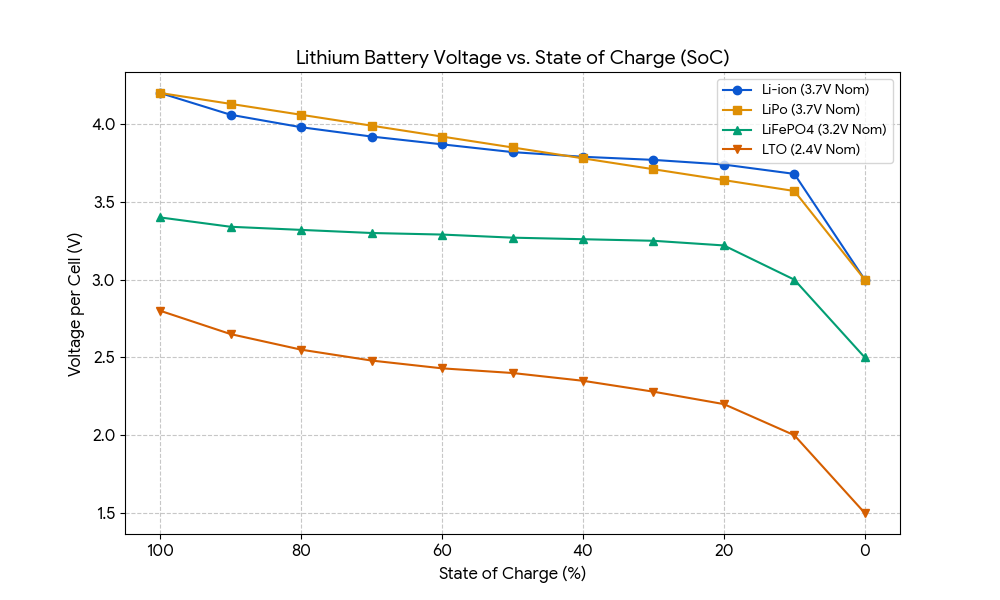
Lithium batteries have different voltage ranges depending on their specific chemistry. The most common are Lithium-Ion (NMC/LCO), Lithium Iron Phosphate (LiFePO4), and Lithium Polymer (LiPo).
Below is a detailed breakdown of voltage vs. State of Charge (SoC), along with charts for common battery pack configurations (12V, 24V, 36V, 48V).
1. Lithium Battery Voltage Chart (Per Cell)
This table provides the Open Circuit Voltage (OCV) measured when the battery is at rest (no load).
| State of Charge (SoC) | Li-ion (3.7V Nom) | LiPo (3.7V Nom) | LiFePO4 (3.2V Nom) | LTO (2.4V Nom) |
| 100% (Full) | 4.20V | 4.20V | 3.40V | 2.80V |
| 90% | 4.06V | 4.13V | 3.34V | 2.65V |
| 80% | 3.98V | 4.06V | 3.32V | 2.55V |
| 70% | 3.92V | 3.99V | 3.30V | 2.48V |
| 60% | 3.87V | 3.92V | 3.29V | 2.43V |
| 50% (Nominal) | 3.82V | 3.85V | 3.27V | 2.40V |
| 40% | 3.79V | 3.78V | 3.26V | 2.35V |
| 30% (Storage) | 3.77V | 3.71V | 3.25V | 2.28V |
| 20% (Low) | 3.74V | 3.64V | 3.22V | 2.20V |
| 10% | 3.68V | 3.57V | 3.00V | 2.00V |
| 0% (Empty) | 3.00V | 3.00V | 2.50V | 1.50V |
*Note: LiFePO4 cells are typically charged to 3.65V, but “settle” to roughly 3.4V once the charger is removed.
2. Standard Pack Voltage Chart (Li-ion / NMC)
Commonly used in electric bikes, scooters, and portable power stations.
| SoC (%) | 12V (3S) | 24V (7S) | 36V (10S) | 48V (13S) | 52V (14S) | 72V (20S) |
| 100% | 12.6V | 29.4V | 42.0V | 54.6V | 58.8V | 84.0V |
| 75% | 11.8V | 27.6V | 39.5V | 51.3V | 55.3V | 79.0V |
| 50% | 11.5V | 26.7V | 38.2V | 49.7V | 53.5V | 76.4V |
| 25% | 11.2V | 26.2V | 37.5V | 48.7V | 52.5V | 75.0V |
| 0% | 9.0V | 21.0V | 30.0V | 39.0V | 42.0V | 60.0V |
3. LiFePO4 Pack Voltage Chart (LFP)
Commonly used for solar energy storage, RVs, and marine batteries.
| SoC (%) | 12.8V (4S) | 25.6V (8S) | 48V (15S) | 51.2V (16S) |
| 100% | 13.6V | 27.2V | 51.0V | 54.4V |
| 90% | 13.4V | 26.7V | 50.1V | 53.4V |
| 50% | 13.1V | 26.1V | 49.0V | 52.3V |
| 20% | 12.9V | 25.8V | 48.3V | 51.5V |
| 0% | 10.0V | 20.0V | 37.5V | 40.0V |
Key Differences & Tips
- Flat Discharge Curve: LiFePO4 batteries have a very “flat” curve, meaning the voltage stays nearly the same from 80% down to 20% SoC. This makes voltage-based percentage meters less accurate for LFP than for Li-ion.
- Storage Voltage: If you are not using your batteries for more than a few weeks, store them at roughly 50% charge (approx. $3.8V$ for Li-ion or $3.25V$ for LFP). This prevents capacity degradation.
- Low Voltage Cut-off: Never allow cells to drop below their 0% limit (usually $2.5V$ for LFP and $3.0V$ for Li-ion). Doing so can cause permanent chemical damage and prevent the battery from recharging.
- Temperature Impact: In cold weather, voltage will sag more under load, and the effective capacity of the battery will decrease.
How to Use a Voltage Chart for Battery Maintenance
Knowing the voltage numbers is only half the battle. Proper application is key to extending battery life and ensuring safety. This section translates chart data into actionable maintenance steps.
Step-by-Step Guide to Checking State of Charge
Follow this simple process to accurately determine your battery’s remaining capacity. Consistency in method ensures reliable results every time.
- Identify Battery Chemistry: Check the label for “LiFePO4,” “Li-ion,” or “LiPo.” This determines which voltage chart to use.
- Measure Open Circuit Voltage (OCV): Let the battery rest for 30+ minutes, then use your multimeter as previously instructed.
- Consult the Correct Chart: Match your measured voltage to the corresponding State of Charge percentage on the appropriate chart.
- Take Action: Recharge if below 20-30%, or disconnect the charger if at 100% (for Li-ion/LiPo).
Interpreting Voltage Readings and Taking Action
Your voltage reading tells a story about battery health and required action. Different ranges signal different priorities.
- Above Full Charge Voltage: Immediately stop charging. This indicates a faulty charger or BMS and is a safety hazard.
- Within Normal Operating Range: Continue normal use. For long-term storage, bring Li-ion/LiPo to ~50% (3.7-3.8V per cell).
- Below Minimum Voltage: Recharge immediately. Consistent deep discharge permanently reduces capacity. A cell below 2.5V may be unrecoverable.
Safety Warning: A battery cell that remains significantly below its minimum voltage after a charging attempt may be damaged. Swollen, hot, or leaking batteries should be disposed of properly.
Common Mistakes to Avoid with Voltage Charts
Small errors can lead to incorrect conclusions and battery damage. Avoid these frequent pitfalls.
Measuring under load is the most common error. It gives a falsely low voltage reading. Always test OCV for chart accuracy.
Using the wrong chart for your chemistry is another critical mistake. Applying a Li-ion chart to a LiFePO4 battery will suggest it’s nearly dead when it’s actually at 50% charge.
Finally, ignoring temperature is an oversight. Voltage readings are temperature-sensitive. Colder temperatures temporarily lower voltage readings, making the battery appear more discharged than it is.
Advanced Voltage Analysis and Troubleshooting
Beyond basic SoC checks, voltage patterns reveal deeper insights into battery health and system issues. This section covers advanced diagnostics for experienced users.
Diagnosing Battery Problems Through Voltage Patterns
Consistent voltage anomalies often point to specific failures. Learning these signs helps you diagnose problems early.
- Rapid Voltage Drop Under Load: Indicates high internal resistance from aging, damage, or cold temperatures. The battery may show full voltage at rest but crash when used.
- Failure to Reach Full Charge Voltage: The battery charges quickly but plateaus below 4.2V (Li-ion) or 3.65V (LiFePO4). This often signals a worn-out cell or a failing BMS.
- Voltage Imbalance Between Cells: In a multi-cell pack, one cell’s voltage is significantly different. This imbalance stresses the pack and reduces total capacity, requiring a balancing charger.
Cell Balancing and Its Impact on Pack Voltage
A battery pack is only as healthy as its weakest cell. Balancing ensures all cells in a series string charge and discharge uniformly.
What is Cell Balancing? It’s the process of equalizing the voltage of individual cells in a series-connected pack. An unbalanced pack’s total voltage is misleading, as a weak cell can be over-discharged while others are still full.
Most modern Battery Management Systems (BMS) include passive balancing. For severe imbalances, a dedicated active balancing charger is required. Regular balancing extends overall pack lifespan significantly.
Expert Insight: If your multi-cell pack’s total capacity has dropped sharply, check individual cell voltages. A single low-voltage cell is often the culprit, creating a “bottleneck” for the entire pack.
Voltage vs. Capacity: Understanding the Relationship
Voltage and capacity are related but distinct concepts. Voltage indicates potential energy (State of Charge), while capacity (measured in Amp-hours, Ah) is the total energy a battery can store.
Aging reduces capacity but not nominal voltage. An old battery may still show a “full” voltage of 4.2V per cell, but it will drop to “empty” much faster because its actual Amp-hour capacity has faded.
Therefore, a voltage chart tells you the current “fuel level,” but it cannot tell you the size of the “fuel tank.” To assess capacity fade, you need to perform a full capacity test by discharging the known-good battery from 100% to 0% while measuring total Amp-hours delivered.
When to Replace Your Battery Based on Voltage
Voltage signals can tell you when a battery is nearing end-of-life. Look for these key indicators of failure.
Inability to Hold a Charge: The battery reaches full voltage but immediately plummets under minimal load. This indicates severely degraded capacity and high internal resistance.
Persistent Cell Imbalance: If one cell consistently requires rebalancing or drags the whole pack down, the pack is failing. A quality BMS can mask this for a while, but performance will suffer.
Finally, if a cell will not recover above its minimum safe voltage (e.g., 2.5V) after a proper charging attempt, it is dead. Continuing to use a pack with a dead cell is unsafe and will damage the remaining cells.
Safety Protocols and Best Practices
Handling lithium batteries requires respect for their energy density. Proper voltage management is intrinsically linked to safety. This section outlines essential protocols to prevent accidents.
Critical Voltage Safety Thresholds
Exceeding these voltage limits can lead to fire, explosion, or permanent failure. Treat them as absolute boundaries, not guidelines.
- Maximum Charge Voltage: Never exceed 4.25V per cell for Li-ion/LiPo or 3.65V for LiFePO4. A quality charger and BMS are your primary safeguards.
- Minimum Discharge Voltage: Do not discharge below 3.0V per cell for Li-ion/LiPo or 2.5V for LiFePO4. Deep discharge can cause internal shorts.
- Storage Voltage: As emphasized, avoid long-term storage at full charge. The ideal, safe range is 3.7V-3.8V per cell for most chemistries.
Handling Damaged or Swollen Batteries
A swollen battery is a clear sign of internal failure and gas generation. It is a significant safety hazard and requires immediate, careful action.
Do not charge, discharge, or puncture a swollen battery. Place it in a fireproof container like a metal ammo can or ceramic pot. Keep it away from flammable materials.
Contact your local waste management facility for proper disposal instructions for lithium batteries. Many electronics retailers also have battery recycling drop-off points. Never dispose of lithium batteries in regular trash.
Emergency Response: If a lithium battery catches fire, use a Class D fire extinguisher if available. Water can be used to cool surrounding cells and prevent thermal runaway, but it will not stop the chemical fire in the burning cell.
Using a Battery Management System (BMS) Effectively
A BMS is not optional for multi-cell packs; it is a critical safety device. It monitors cell voltages and protects the pack.
Understand Your BMS’s Role: It performs over-voltage protection (OVP), under-voltage protection (UVP), and short-circuit protection. It may also handle cell balancing and temperature monitoring.
Do not bypass or disable BMS protections. If your BMS frequently cuts off power, diagnose the root cause (e.g., a weak cell, excessive load) instead of removing the safeguard. A functioning BMS is your best partner in applying voltage chart knowledge safely.
Application-Specific Voltage Guidelines
Different uses for lithium batteries have unique voltage management priorities. These tailored guidelines help you optimize performance and lifespan for your specific application.
Electric Vehicles and E-Bikes
EV and e-bike batteries experience high current demands and deep cycles. Voltage management here is crucial for range and pack longevity.
- Daily Charging: Charge to 80-90% for daily use to reduce stress. Save 100% charges for long trips where you need maximum range.
- Winter Storage: If storing for winter, charge the pack to ~60% (approx. 3.7-3.8V per cell). Store in a cool, dry place and check voltage monthly.
- Monitor Cell Balance: Use your system’s display or app to check for cell voltage imbalance. Significant imbalance reduces total range and indicates a need for service.
Solar Power and Off-Grid Storage
LiFePO4 is the dominant chemistry here due to its cycle life and safety. Voltage settings in your solar charge controller are paramount.
Configure your charge controller’s absorption and float voltages according to your battery’s specs, not default lead-acid settings. For a 12.8V LiFePO4, typical settings are Absorption: 14.2V-14.6V, Float: 13.5V (or disable float).
Set a low-voltage disconnect (LVD) in your inverter or controller to prevent discharge below 20% SoC (approx. 12.8V for a 12V system). This protects your investment from deep discharge damage.
Solar Pro Tip: Size your solar array and battery bank so you rarely discharge below 50% State of Charge on average. This dramatically extends the battery’s usable lifespan in years.
RC Hobbies, Drones, and Consumer Electronics
These applications use high-performance LiPo and Li-ion packs. Voltage discipline is non-negotiable for safety and performance.
Use a LiPo-Specific Charger: Always use a smart charger with balance leads. Never leave charging batteries unattended. Charge at 1C or lower for longevity unless the battery specifies otherwise.
Respect the “Storage” Function: After a day of flying or racing, use your charger’s “Storage” mode. It will automatically charge or discharge each cell to the safe 3.8V level. This is the single best habit for RC battery care.
For smartphones and laptops, avoid constantly keeping them plugged in at 100%. If possible, use software features that limit maximum charge to 80-85% to slow capacity fade.
Conclusion: Mastering Your Lithium Battery Voltage Chart
Understanding your lithium battery voltage chart is the key to unlocking maximum performance, safety, and lifespan. This guide provided the essential charts for LiFePO4, Li-ion, and LiPo chemistries. You now have the knowledge to accurately gauge state of charge and health.
The single most important practice is to measure Open Circuit Voltage regularly and avoid the extreme high and low ends of the charge spectrum. Pair this with using the correct tools and safety protocols.
Start by identifying your battery’s chemistry and taking a baseline voltage reading today. Download or bookmark the relevant chart for quick reference during your next maintenance check.
With consistent voltage monitoring, you can confidently manage any lithium-powered device, from small gadgets to large solar systems, ensuring reliable power for years to come.
Frequently Asked Questions about Lithium Battery Voltage
What is a normal voltage for a 12V lithium battery?
A “12V” lithium battery’s normal voltage depends on its chemistry. A fully charged 12.8V LiFePO4 battery reads about 14.6V, while a resting one is 13.2-13.4V. A less common 12V Li-ion (3S) pack reads 12.6V when full. Always check your battery’s specification sheet for its exact nominal and charging voltages.
Never assume 12.6V is full for lithium. Using a lead-acid voltage reference will lead to chronic undercharging of LiFePO4 batteries, drastically reducing their capacity and lifespan over time.
How to tell if a lithium battery is bad using a multimeter?
A bad battery often shows voltage abnormalities. First, check if it won’t hold a charge—it reaches full voltage but drops rapidly under a small load. Second, measure individual cell voltages in a multi-cell pack; a significant imbalance (more than 0.1V difference) indicates a failing cell.
Finally, if a fully charged battery’s open circuit voltage is significantly below its specified maximum (e.g., below 4.1V per cell for Li-ion), it has likely lost substantial capacity. A swollen physical appearance is a definitive visual sign of failure.
What voltage is 50% for a LiFePO4 battery?
For a single LiFePO4 cell (3.2V nominal), 50% State of Charge is approximately 3.3 volts. For a common 12.8V battery (4 cells in series), this translates to about 13.2 volts. The voltage curve of LiFePO4 is very flat between 20% and 90% SoC, making voltage a less precise indicator in this middle range.
Due to this flat curve, a smart battery monitor (like a Victron BMV) that tracks amp-hours consumed is often more accurate for determining the exact 50% point of a LiFePO4 battery during use.
Is 3.3 volts good for a lithium-ion battery?
3.3 volts per cell is low for a standard Li-ion battery and indicates a very depleted state. It is near the critical minimum threshold, which is typically 3.0V. At 3.3V, the battery is likely below 10-15% State of Charge and should be recharged immediately to prevent damage.
For long-term storage, 3.3V is too low. The ideal storage voltage for Li-ion is 3.7V to 3.8V per cell (approx. 50% charge). Storing at 3.3V can lead to deep discharge over time as the battery self-discharges further.
Why does my battery voltage drop so fast under load?
A rapid voltage drop under load is a classic symptom of high internal resistance. This can be caused by an aged battery where chemical degradation has occurred, extremely cold temperatures, or a poor connection at the terminals. It means the battery cannot deliver its current efficiently.
This condition also causes the voltage to “bounce back” significantly when the load is removed. If a battery is new and exhibits this, it may be defective, undersized for the application, or have damaged cells.
What is the best way to charge a lithium battery based on voltage?
The best way is to use a smart charger specifically designed for your battery’s chemistry (LiFePO4, Li-ion, etc.). These chargers follow the correct constant-current/constant-voltage (CC/CV) profile and automatically stop at the correct maximum voltage (e.g., 14.6V for 12.8V LiFePO4).
For longevity, avoid charging to an absolute 100% daily unless necessary. If your charger allows, set it to stop at 90% (approx. 14.0V for LiFePO4 or 4.1V per cell for Li-ion). This significantly reduces stress on the battery compared to always charging to the maximum voltage ceiling.
Can you recover a lithium battery that has been over-discharged?
Recovery is sometimes possible if the voltage has not been below the minimum for too long. Use a quality charger with a “repair” or “wake-up” feature that applies a very low trickle charge to gently raise the cell voltage above 3.0V before beginning a normal charge cycle.
Success is not guaranteed. Even if recovered, the cell will have suffered permanent capacity loss. If a cell remains below 2.0V for an extended period, it is usually unrecoverable and may be unsafe due to internal copper shunting, posing a fire risk if charged.
How accurate is voltage for measuring state of charge?
Voltage is a good but imperfect indicator of State of Charge. It is most accurate at the high and low ends of the charge curve and when measured as Open Circuit Voltage (at rest). It is less precise in the middle ranges, especially for LiFePO4 batteries which have a very flat voltage plateau.
For the most accurate SoC measurement, a battery monitor that uses a shunt to track amp-hours in and out (coulomb counting) is superior. Voltage should be used as a quick check and for verifying the cutoff points provided by such a monitor.